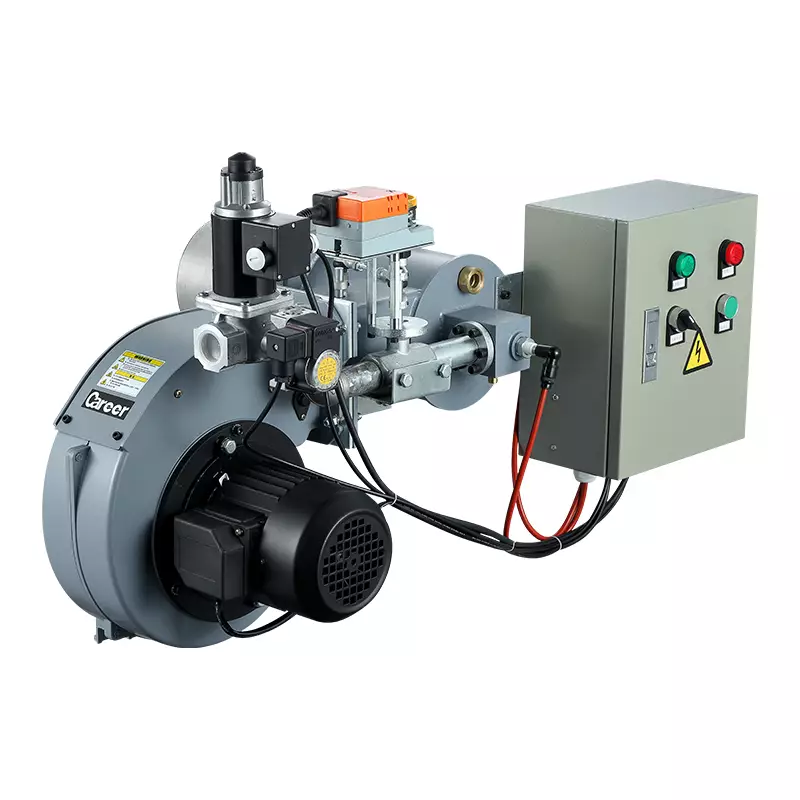
Temperature control becomes difficult when a burner can only operate at a few fixed firing levels. Process heat demand changes continuously, yet an on/off or stepped system may respond with more heat than required or no heat at all. A modulating gas burner addresses the mismatch by varying its firing rate so heat input can follow the process more closely.
Career Burner’s BX20 provides a concrete example, using continuous mechanical modulation, automatic fuel/air flow regulation, and a 40:1 turndown ratio. Its published output range is 5.3–232.2 kW.
Temperature Accuracy Starts With Matching Heat Input to Demand
A temperature controller can measure process temperature precisely, but the heat source also needs enough resolution to respond to changing demand.
As a process approaches its target, maximum burner output may be unnecessary, while shutting the burner off could remove too much heat. Intermediate firing becomes the useful control region.
A modulating gas burner can adjust thermal input through that region rather than relying on repeated full-fire and no-fire cycles. The closer the firing range corresponds to process load, the easier it becomes for the control loop to make smaller corrections.
What Continuous Modulation Changes
The BX20 uses a servo motor and mechanical linkage for load adjustment. Its product specification identifies continuous modulation and a 40:1 modulation ratio.
Continuous modulation means the burner is designed to vary its firing rate progressively across its specified range. It can increase heat when temperature falls and reduce heat as the target is approached.
A wider usable firing range also reduces binary decisions. Instead of fully on or off, the control system can operate at an intermediate firing level when the process requires intermediate heat input.
Why Lower Firing Can Reduce Temperature Overshoot
Overshoot occurs when thermal input exceeds what is needed to reach the setpoint, while stored heat continues pushing temperature upward.
Burner modulation does not automatically eliminate overshoot. Process lag, sensor placement, controller tuning, thermal mass, and heat transfer still influence the result. However, reducing burner output gives the control system another response before the process moves beyond its target.
This is particularly relevant to an industrial hot air burner. The BX20 is described as a hot air burner that supplies heated process air directly, with its firing rate matched to the air-temperature requirement of the process.
Variable heat input therefore gives the system a practical way to adapt burner output to changing thermal demand.
Turndown Determines How Far Output Can Be Reduced
Maximum firing rate tells only part of the temperature-control story. A burner also needs a defined lower operating point. The ratio between maximum and minimum firing rates is its turndown ratio.
Career Burner specifies the BX20 at 40:1. Its published natural-gas consumption is 0.55–23.0 m³/h, with output power of 5.3–232.2 kW.
A 40:1 ratio represents a broad firing range between the stated minimum and maximum conditions, useful when a process moves from high heat demand toward a lower maintenance load.
Turndown should not be interpreted as a guarantee of particular temperature accuracy. Actual results depend on the complete installation, including heat-transfer equipment, temperature sensing, control logic, fuel conditions, and operating requirements.
Fuel-Air Control Has to Follow the Firing Rate
Changing fuel input without appropriately managing combustion air would undermine controlled operation. The BX20 specification identifies forced-draft air supply and automatic fuel/air flow regulation as part of its design.
The combustion system must maintain intended firing conditions as load changes.
Career Burner also identifies natural gas and LPG compatibility for the BX20. Fuel selection and combustion setup belong to the complete burner installation.
Where Modulation Provides the Most Value
The strongest case for modulation appears in processes with changing thermal demand. Textile dyeing and finishing are specifically identified on the BX20 product page as applications for the burner, alongside stated suitability for dynamic heat loads.
Continuous output adjustment gives the burner more opportunity to track changing demand than fixed firing positions.
Sensor accuracy, controller configuration, response time, thermal inertia, installation geometry, and maintenance condition also affect the final temperature profile.
Choosing the Control Range Around the Process
Temperature accuracy should be evaluated from the process backward. Required temperature range, normal heat load, peak recovery requirement, minimum sustained load, and response characteristics should be established before judging modulation capability.
A hot air burner may suit direct process-air heating, but it still has to be matched to the air system and process duty. The relevant question is whether its controllable firing range gives the temperature-control system enough room to respond to real load changes.
The BX20 offers a published 5.3–232.2 kW output range and continuous 40:1 modulation. Those specifications help evaluate whether the burner fits a duty; they are not a universal measure of temperature accuracy.
Precision Comes From the Complete Control Loop
A modulating burner improves temperature control by providing a variable heat source instead of forcing the process into coarse firing steps. Continuous modulation, an appropriate turndown range, and coordinated fuel-air regulation create flexibility to respond to changing demand.
Career Burner’s BX20 illustrates the concept through its continuous mechanical modulation and published 40:1 ratio. Ultimately, accurate temperature control comes from the interaction of burner capacity, modulation range, combustion control, sensing, and process dynamics—not from the modulation ratio alone.
