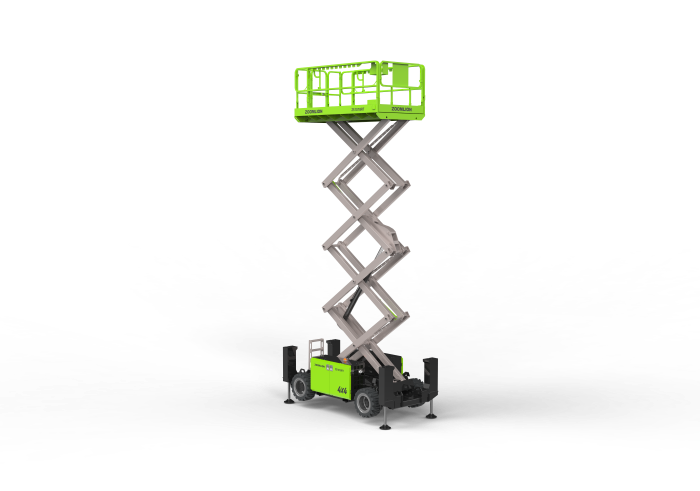
Contractors rarely need a machine simply because it has a certain working height. For dealers, a stronger sales conversation starts with the job: ground conditions, crew size, materials, access routes, duty cycle, and project duration. A rough terrain scissor lift can then be positioned for outdoor elevated work where mobility, platform space, and terrain capability must work together.
Start With Contractor Applications
The first step is to identify recurring contractor applications. Structural work, installation, façade finishing, bridge maintenance, and outdoor industrial construction can create different requirements for height, capacity, and maneuverability.
Ask clients where the machine will work, what they need to carry, how many workers will use the platform, and how often the machine will move. This turns a generic equipment inquiry into an application profile that supports a more precise recommendation.
Sell the Working Envelope, Not Just Height
Working height is only one part of the machine’s value. Dealers should explain how platform dimensions, extension length, capacity, turning radius, and travel capability influence the usable working area.
A larger scissor lift platform can allow workers to keep tools and materials close while performing repetitive tasks. However, greater dimensions can affect transport and maneuverability. The right sales discussion balances workspace with the contractor’s actual site constraints.
Use Terrain as a Qualification Point
Outdoor contractors often work on compacted soil, gravel, slopes, or uneven ground. A rough terrain scissor lift should therefore be discussed in relation to ground conditions rather than presented as a general-purpose replacement for every access machine.
Before recommending a unit, dealers can ask about grade, surface quality, soft spots, site preparation, and expected weather conditions. OSHA guidance also emphasizes assessing operating surfaces, stability, and manufacturer requirements when aerial lifts are used.
Make Capacity Relevant to the Crew
Platform capacity becomes more meaningful when translated into the contractor’s work package. Consider the number of workers, tools, components, and consumables that may be carried together.
For dealers, this can reveal whether a client needs a compact machine for personnel access or a higher-capacity unit for material-intensive tasks. The scissor lift platform should be evaluated at the intended working height and with the extension deck considered where applicable, rather than relying only on maximum rated capacity.
Position Mobility as a Productivity Factor
Mobility can influence how much time crews spend repositioning equipment. A machine that can drive effectively across the site may reduce interruptions between work areas, provided the manufacturer permits travel under those conditions.
Explain turning radius, gradeability, ground clearance, drive height, and stowed dimensions as part of the operating picture. These specifications help contractors judge whether the machine can move between work zones without creating unnecessary logistics problems.
Connect the Machine to Project Logistics
Dealers should also qualify how the equipment will arrive, move through the site, and leave. Ask about gate widths, access roads, loading areas, transport equipment, and trade sequencing.
This is particularly important on developing construction sites. A machine that fits an empty site may encounter scaffolding, stored materials, barriers, or structures later. Positioning should therefore consider the complete project environment, not just the work face.
Build the Offer Around Contractor Concerns
Contractors may compare equipment through purchase price, utilization, service requirements, delivery timing, and parts availability. Dealers can make the proposal more useful by separating technical fit from scope.
A clear quotation can show the machine configuration, included equipment, optional attachments or accessories, warranty terms, service arrangements, delivery assumptions, and documentation. This gives the contractor a transparent basis for evaluating the offer.
Position ZS1018RT by Application
For a compact diesel rough-terrain option, Zoomlion Access lists the ZS1018RT with a maximum working height of 12 m and platform capacity of 500 kg. Their official specification lists a 2.90 m platform length, 1.52 m platform width, and 1.5 m platform extension, giving dealers concrete figures to discuss when matching workspace requirements.
The ZS1018RT uses 4WD, solid tires, and has 0.24 m ground clearance and 40% gradeability. Its listed stowed drive capability is full-height operation, while the machine has a 2.0 m inside turning radius and 4.2 m outside turning radius. These figures help dealers connect terrain and maneuverability to contractor applications.
Use Zoomlion Access Specifications in the Sales Conversation
When positioning the ZS1018RT, Zoomlion Access dealers can lead with the contractor’s application and then use the published specifications to support the recommendation. The 500 kg platform capacity, 12 m working height, 1.5 m extension, 4WD, and 40% gradeability provide measurable points for comparing site requirements.
The manufacturer also states that its portfolio includes more than 100 MEWPs across five categories, including scissor lifts, boom lifts, telehandlers, and spider lifts. For dealers, that range can support application-based conversations when a contractor’s requirements extend beyond one access-machine type.
Make the Recommendation Easy to Understand
A dealer proposal should make the contractor’s decision traceable: project conditions lead to application requirements, application requirements lead to specifications, and specifications lead to a machine configuration. That is better than presenting features without context.
For outdoor projects requiring elevated access on demanding surfaces, position the rough terrain scissor lift around the combination of platform capacity, working height, mobility, and terrain suitability. With the relevant scissor lift platform data and Zoomlion Access specifications clearly presented, dealers can make their recommendations easier for contractor clients to evaluate.
