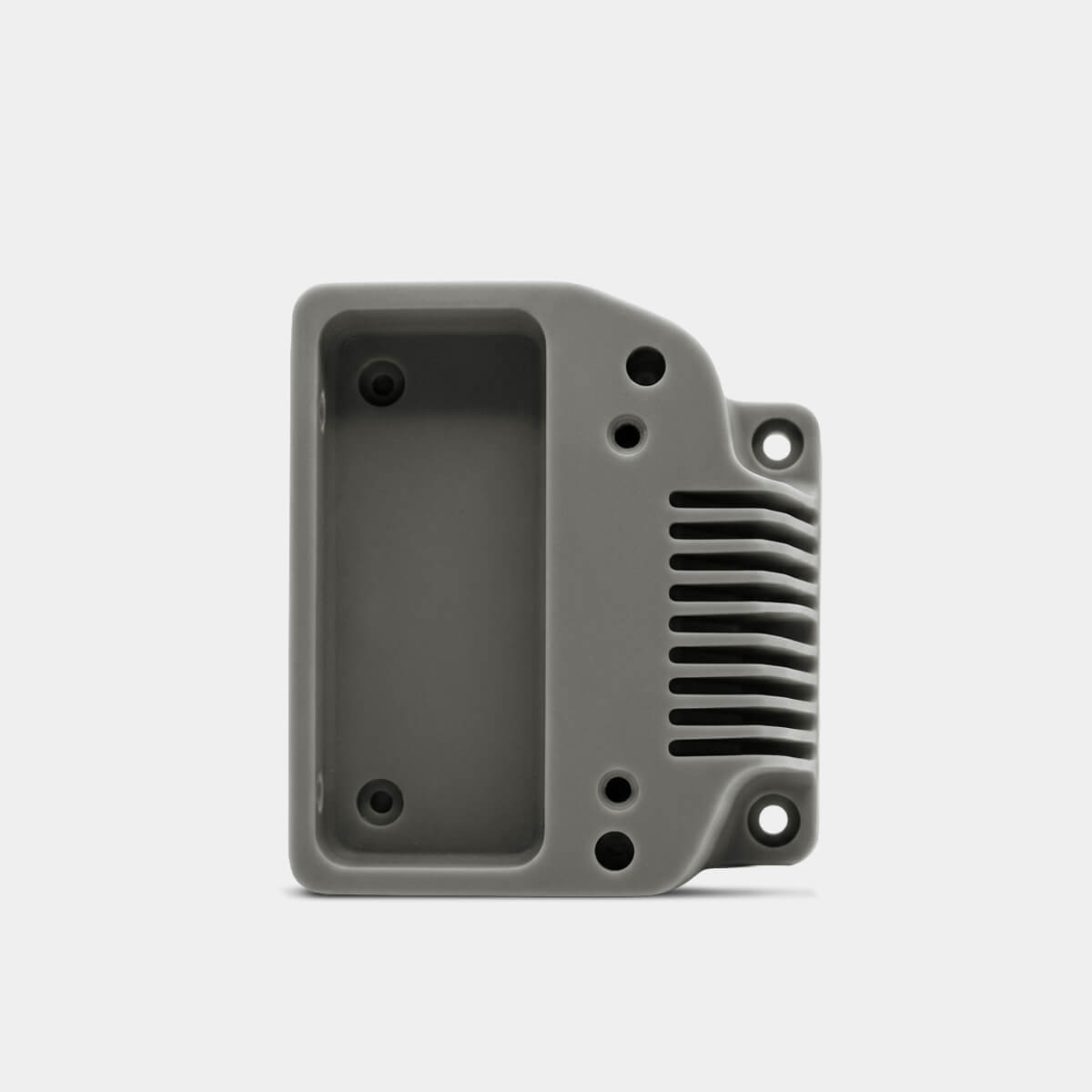
Heat exposure can change the performance of a 3D-printed component long after it leaves the printer. For businesses using resin 3D printing, selecting a material according to its operating environment is therefore an important part of application planning. Standard resin can support many everyday models and prototypes, while high temp resin is developed for applications where elevated temperatures place greater demands on dimensional and structural stability.
Why Heat Deflection Temperature Matters
Heat deflection temperature (HDT) is a useful reference when comparing engineering materials for applications involving heat. It indicates the temperature at which a material deforms under a specified load and test condition. It should not be interpreted as a universal maximum service temperature for every application.
The distinction is particularly relevant when evaluating resin 3D printing materials. A printed component may experience heat from engines, machinery, testing equipment, molds, lighting systems, or other sources. If the material softens or loses dimensional stability under those conditions, the printed part may no longer perform as intended.
Standard Resin for Everyday Printing
SUNLU Standard Resin is positioned as an entry-level resin designed for stable and reliable printing. Its published heat deflection temperature is 55°C, while its tensile strength is 45 MPa, flexural strength is 57 MPa, and elongation at break is 13.5%. The material also has a published viscosity range of 300–600 mPa.s/℃.
These characteristics make standard formulations relevant to applications where extreme heat resistance is not a primary requirement. Typical business uses can include visual models, concept prototypes, design verification, and other general-purpose parts. For these workflows, print stability, detail reproduction, and ease of processing may be more important than specialized thermal performance.
However, a 55°C HDT provides an important boundary for application planning. Businesses should not assume that a component printed with standard resin will maintain the same mechanical and dimensional behavior when exposed to substantially higher temperatures. Thermal requirements should be assessed before the material is approved for functional use.
High Temp Resin for Demanding Applications
SUNLU High Temperature Plus Resin takes a substantially different approach. It is an engineering-grade material with a published heat deflection temperature of 170°C. SUNLU also specifies short-term resistance to temperatures of up to 300°C for approximately three minutes without deformation.
The difference between the two HDT figures is substantial: 170°C for the High Temperature Plus formulation compared with 55°C for SUNLU Standard Resin. This makes thermal performance a clear material-selection distinction rather than a minor variation between two general-purpose products.
SUNLU High Temperature Plus Resin is also specified with a tensile strength of 32 MPa, flexural strength of 82 MPa, notched Izod impact strength of 25 J/m, elongation at break of 7%, and Shore hardness of 87. Its published viscosity range is 200–500 mPa.s/℃.
Short-Term Heat Resistance Is Not Continuous Service
The 300°C figure deserves careful interpretation. SUNLU describes this capability as short-term exposure of approximately three minutes, rather than continuous operation at 300°C. Consequently, a high temp resin should not automatically be treated as suitable for uninterrupted service at that temperature.
For procurement and engineering teams, the distinction helps prevent specifications from being misunderstood. The expected temperature, duration of exposure, mechanical load, and surrounding conditions should all be considered when qualifying a printed component. A thermal test should reflect the actual application rather than relying on a single headline number.
Choosing Between the Two Materials
The choice ultimately depends on the operating environment. If a printed part is primarily used for visualization, general prototyping, or applications with moderate temperatures, standard resin may provide the properties required without introducing unnecessary material specialization.
When the part must retain structural stability under prolonged elevated temperatures, a high temp resin becomes more relevant. SUNLU describes its High Temperature Plus Resin for high-temperature functional applications, mold verification, structural testing, and functional components. Its high hardness is also presented as an advantage for engineering-oriented applications.
Businesses should also account for printing parameters when qualifying a material. SUNLU lists recommended layer exposure times of 3–15 seconds for color LCD systems and 2–3.5 seconds for monochrome LCD systems for High Temperature Plus Resin. The manufacturer also emphasizes complete curing because insufficient curing can affect heat resistance.
Making Heat Resistance Part of Material Selection
For professional resin 3D printing, heat resistance should be evaluated alongside strength, dimensional requirements, printing conditions, post-processing, and the intended service environment. The comparison between 55°C and 170°C HDT illustrates why a general-purpose resin and an engineering resin should not be treated as interchangeable materials.
SUNLU provides both standard and engineering-oriented resin options, allowing users to align material selection with different project requirements. Its High Temperature Plus Resin offers a 170°C HDT and short-term 300°C resistance, while Standard Resin provides a 55°C HDT for general applications.
For businesses selecting materials, the most appropriate approach is to begin with the actual thermal conditions of the application and then validate the selected resin through representative testing. This helps ensure that the chosen material is evaluated according to real operating requirements rather than relying solely on its product category.
